For most Long Island homeowners, the answer is yes — removing the wall between your kitchen and living or dining area is one of the highest-impact changes you can make to how a home feels and functions. But "worth it" depends on what's behind that wall, how your household lives, and whether the structural and permit work fits your budget. Here is what you need to know before swinging a sledgehammer.
Why Open-Concept Kitchens Are Still Winning
The demand has not peaked. Buyers on Long Island consistently pay a premium for open layouts, and families with young children or older relatives cite sightlines and supervision as the top practical reason to open things up. Beyond resale, the day-to-day benefit is real: natural light travels farther, cooking stops feeling like an isolated chore, and smaller square footage reads as larger once the visual barriers come down.
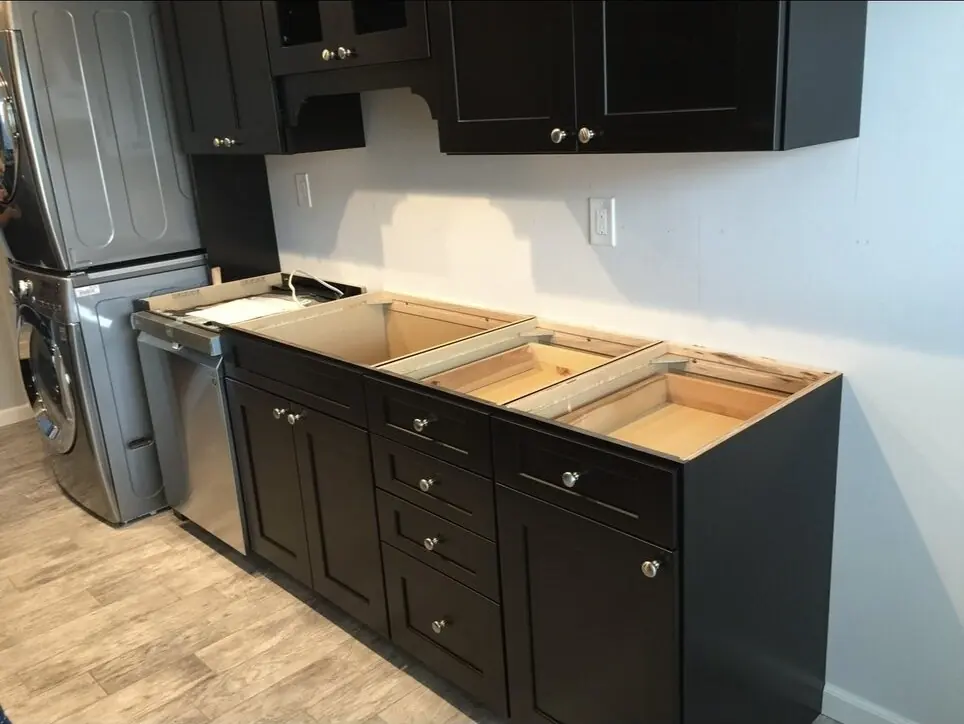
If you are already thinking about a kitchen remodeling project — new cabinets, countertops, appliances — pairing it with a wall removal is almost always more cost-efficient than doing them separately. Labor overlaps, the kitchen is already disrupted, and finishing decisions like flooring and paint become unified.
The First Question: Load-Bearing or Not?
This is the make-or-break determination. A non-load-bearing partition wall is straightforward to remove — demo, patch, refinish. A load-bearing wall requires an engineered header or beam to carry the load the wall was transferring to the foundation. Both are done every day by experienced contractors, but the cost and complexity are different.
General indicators that a wall may be load-bearing:
- It runs perpendicular to floor joists
- It sits above a beam or foundation wall in the basement
- There is another wall directly above it on a second floor
- It is near the center of the house rather than along an exterior
No visual inspection is conclusive. A licensed contractor will open a small section, check the framing, and in most cases consult architectural drawings or an engineer before committing to the approach. At Milton's Construction we handle this assessment as part of the planning process — our architecture and design team can coordinate structural review so you have a clear scope before any work begins.
What Else Is in That Wall?
Walls between kitchens and adjacent rooms commonly contain:
- Electrical circuits — outlets, switches, and sometimes the panel feed for kitchen appliances
- Plumbing supply or drain lines, especially if a wet bar or peninsula sink is planned
- HVAC ductwork serving both rooms
- Gas lines in older Long Island homes, particularly pre-1980 construction
Each of these can be rerouted, but each adds cost and requires its own licensed trade. Electrical rerouting on a straightforward wall project might add $800 to $2,500. If a drain line needs to move, expect $1,500 to $4,000 depending on access and whether concrete needs to be cut. Our licensed plumbing team handles rerouting in-house, which keeps the schedule cleaner than coordinating separate subcontractors.
Realistic Cost Ranges for Long Island
Wall removal projects vary considerably based on structural complexity, what is hidden inside, and how much finish work follows. As a working range for Nassau and Suffolk County:
- Non-load-bearing wall, no utilities: $1,200 to $3,500 all-in, including demo, patching, paint, and floor blending
- Load-bearing wall with beam installation: $4,500 to $12,000 depending on span, beam type (LVL vs. steel), and column or post requirements
- Wall with significant utility relocation: Add $2,000 to $8,000 on top of structural costs depending on what is found
These ranges assume the removal is paired with a broader kitchen remodel. Standalone wall removal without cabinet or finish work tends to run on the lower end of each range. Get a specific estimate — scopes differ too much for a single number to be reliable. You can explore financing options through our partner Enhancify at our financing page if the full project scope stretches the budget.
Permits and Long Island Code
In Suffolk and Nassau counties, structural alterations — including removal of load-bearing walls — require a building permit. Non-load-bearing removals typically still need a permit if electrical or plumbing work is involved. Pulling permits is not optional and is not something to skip to save a few hundred dollars: unpermitted structural work creates title problems when you sell, voids homeowner's insurance for related claims, and can require costly remediation if discovered during inspection.
The permit timeline in most Long Island municipalities runs two to six weeks for residential structural work. We manage the permit application process for our clients in Suffolk County and across Long Island as a standard part of the project — you do not need to navigate the building department yourself.
Design Decisions That Come With the Territory
Once the wall is gone, a few decisions become unavoidable:
- Flooring continuity: If the kitchen has tile and the adjacent room has hardwood, the transition now reads as a seam in the middle of your living space. Many homeowners use this moment to run consistent flooring through both rooms.
- Kitchen ventilation: Open layouts need a more powerful range hood because cooking odors now travel freely. Plan for 400 to 600 CFM minimum in an open kitchen — your HVAC should be reviewed at the same time. We are an authorized MRCOOL distributor and installer and can assess whether your existing system handles the merged space efficiently.
- Defining the kitchen boundary: A peninsula, island, or change in ceiling treatment helps anchor the kitchen visually without the wall. Budget for this if you want the layout to feel intentional rather than incomplete.
- Noise and smells: Open concept means sounds and cooking odors reach the whole floor. Most families find this an acceptable trade-off, but it is worth naming before you commit.
Timeline to Expect
A wall removal paired with a kitchen remodel typically adds one to two weeks to the overall project schedule. Structural work, inspections, and utility rerouting each need their own phase. A standalone wall removal with no utility complications can be completed in three to five business days once permits are in hand.
Is It Worth It?
For the overwhelming majority of Long Island homes — particularly Cape Cods, raised ranches, and split-levels where kitchens were originally compartmentalized — yes. The functional improvement is immediate, the resale impact is measurable, and when done correctly it does not compromise the structural integrity of your home in any way. The key is doing it correctly: proper engineering, licensed trades, and permits pulled before demo begins.
Milton's Construction has been doing this work on Long Island for 40 years. We handle the full scope in-house — structural assessment, permits, demo, framing, electrical, plumbing, and finish — so there is one point of contact and one accountable team from first hammer to final walkthrough. Browse our project gallery to see open-concept kitchen transformations we have completed across the area.
Ready to find out what is in your wall and what it will actually cost? Call us at (631) 741-0199 or request a free estimate online. We serve homeowners throughout West Babylon, Long Island, and the Tri-State area and are happy to come take a look with no obligation.

Founder of Milton's Construction. Four decades building and remodeling homes across Long Island. More about us →