Ductless mini-splits are ideal for Long Island homes without existing ductwork, additions, and zoned comfort — they install fast and cut energy bills. Central air makes sense when you already have ducts or want whole-home cooling from one system. Mini-splits cost $3,000–$8,000+ per system; central air $7,000–$15,000+.
- Mini-splits: no ductwork, room-by-room zoning, efficient
- Central air: best if ducts already exist, one whole-home system
- Mini-splits shine in older homes and additions
- Both heat and cool with modern heat-pump technology
One of the most common questions we hear from Long Island homeowners is whether they should put in a ductless mini-split or stick with traditional central air. There is not one right answer—the correct choice depends on your home's construction, your existing infrastructure, your budget, and what comfort problem you are actually trying to solve. Here is the full picture.
How Each System Works
Central air conditioning uses a single outdoor condenser, a furnace or air handler in a closet or basement, and a network of metal or flex ductwork running through walls, ceilings, and attic spaces to deliver conditioned air to every room from a central point. A single thermostat typically controls the whole house.
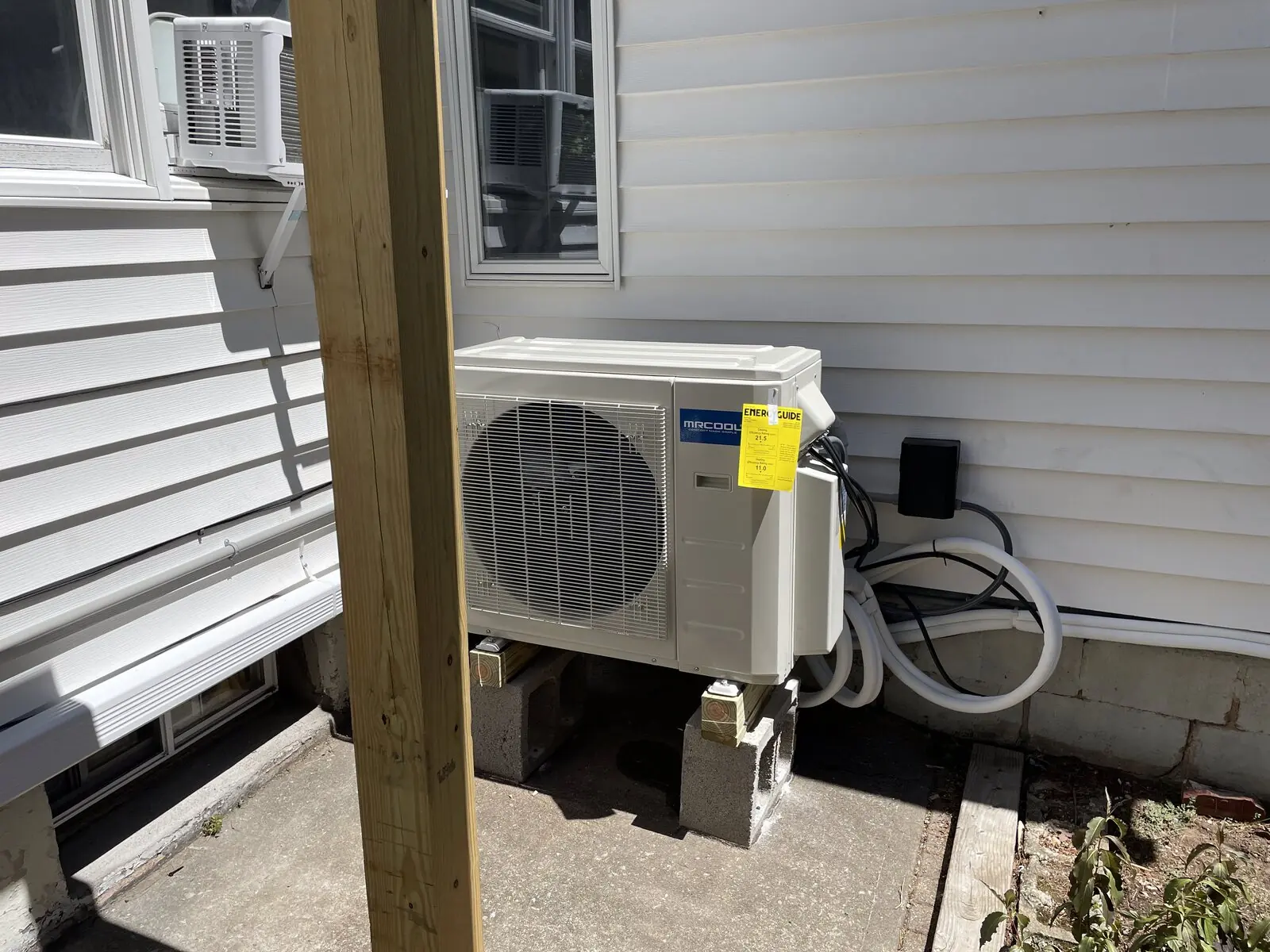
Ductless mini-splits use one outdoor compressor connected to one or more indoor air-handling units mounted on walls or ceilings. Refrigerant lines run through a small penetration in the wall—no ductwork required. Each indoor head has its own thermostat and can be set independently.
Installation Cost
This is where the comparison gets complicated, because the starting conditions matter enormously on Long Island.
If your home already has existing ductwork in good condition, a standard central AC replacement typically runs in the $4,000–$8,000 range for a straightforward swap. If your ducts need repairs, cleaning, or replacement, or if your home has no existing ductwork, that number climbs significantly—sometimes to $15,000–$25,000 or more for a full duct installation in a finished home.
A single-zone mini-split installation for one room or one addition runs roughly $2,500–$5,000 installed, depending on the unit and what the electrical situation looks like. A whole-home multi-zone mini-split system serving four to six zones can run $12,000–$20,000 or more. A free written estimate from us gives you the exact number for your specific home. Call or text 631-741-0199 to get started.
The Ductwork Factor: Why This Matters for Long Island Homes
A large share of Long Island's housing stock was built in the post-war era—the 1950s through the 1970s. Many of these Cape Cods, split-levels, and ranches were not designed with central air in mind. Retrofitting ductwork into a finished home with low attic clearance or no accessible ceiling space is expensive and invasive. You are looking at drywall cuts, ceiling drops, or compromises in where supply registers end up.
For homes like these, ductless mini-splits are often the practical choice. The line set runs through a three-inch hole. The indoor head mounts on the wall. The outdoor unit sits on a pad outside. No ductwork, no dropped ceilings, no months of renovation.
For homes that already have a functioning duct system from an oil furnace or a previous central air installation, it often makes more sense to work with that existing infrastructure rather than install a parallel mini-split system.
Zoning and Comfort Control
Central air with a single thermostat treats the whole house as one zone. If someone runs hot in the upstairs bedroom and someone else runs cold in the living room, there is no good solution short of adding a zoning controller and multiple dampers—which is its own cost and complexity.
Mini-splits are inherently zoned. Each indoor head is its own zone. The bedroom can be set to 68 degrees while the living room runs at 72. The spare room that no one uses does not get cooled at all. For families with different comfort preferences or for homes where certain rooms get more sun exposure, this zoning is genuinely valuable and often shows up in lower energy bills over time.
Efficiency
Modern mini-splits, including the Mr. Cool systems we install, typically run at 20–22 SEER or higher. A standard central air system from a major brand runs 14–18 SEER. Higher-end central systems can reach 20 SEER, but they cost more.
Mini-splits also avoid duct losses. Studies have shown that duct systems in unconditioned spaces like attics can lose 20–30% of conditioned air to leakage and heat transfer before it ever reaches the living space. A mini-split delivers conditioned refrigerant directly to the room—no duct, no loss. On a Long Island summer day when your attic is running 130 degrees, that difference is not theoretical.
Heating Performance
Central air is an air conditioner. It does not heat. You need a separate furnace for that. Mini-splits are heat pumps—they both cool in summer and heat in winter from the same equipment. Modern cold-climate mini-splits heat efficiently down to -13°F, which covers everything a Long Island winter will throw at you. For homes without existing gas service or where oil heat is being phased out, a heat pump mini-split handles both seasons from one installation.
Best Fit by Situation
- Home addition or converted garage: Mini-split almost always wins. Running new ductwork to an addition is expensive and often impossible without major work. A single-zone mini-split is the clean solution.
- Older Cape Cod or split-level with no existing ducts: Multi-zone mini-split system is typically more cost-effective and less invasive than a full duct retrofit.
- Home with existing duct system in good condition: Central air replacement is often the more economical path, especially if you already have a forced-air furnace.
- Large home where everyone wants independent temperature control: Multi-zone mini-split gives you that capability. A zoned central system can too, but it requires dampers, multiple thermostats, and a more complex installation.
- Tight budget, one problem room: A single-zone mini-split for the room that never gets comfortable is often the fastest and most affordable fix, especially if the rest of the house is adequately served.
Talk to Someone Who Installs Both
Milton's Construction installs ductless mini-splits, including Mr. Cool systems, and we also do central air installation, replacement, and duct work. We have been doing HVAC and general contracting across Long Island for four decades. We will tell you which system actually makes sense for your home—not which one has the better margin for us that week.
Get a free written estimate and a straight conversation about what fits your situation. Visit our contact page or call and text us at 631-741-0199. We serve West Babylon, the South Shore, and the broader Long Island area.

Founder of Milton's Construction. Four decades building and remodeling homes across Long Island. More about us →