For Long Island's relatively mild winters, a modern heat pump (including ductless mini-splits) is highly efficient and provides both heating and cooling from one system, often lowering energy bills. A gas furnace still delivers strong, low-cost heat in deep cold. Many homes do best with a heat pump plus a backup heat source.
- Heat pumps heat AND cool efficiently in Long Island's climate
- Gas furnaces provide strong heat in extreme cold
- Heat pumps can cut energy costs and qualify for rebates
- A hybrid (heat pump + backup) covers all conditions
If you are heating a home on Long Island and trying to decide between a heat pump and a gas furnace, the short answer is: a modern cold-climate heat pump handles Long Island winters better than most homeowners expect, but a high-efficiency gas furnace still makes sense in specific situations. The right choice depends on your home's existing infrastructure, your utility costs, your long-term plans, and whether you are replacing a single unit or doing a broader renovation. Here is what you need to know before making the call.
How Each System Works
A gas furnace burns natural gas (or propane) to generate heat and distributes it through ductwork. It is a proven, straightforward system and the dominant choice in Long Island homes built before 2000.
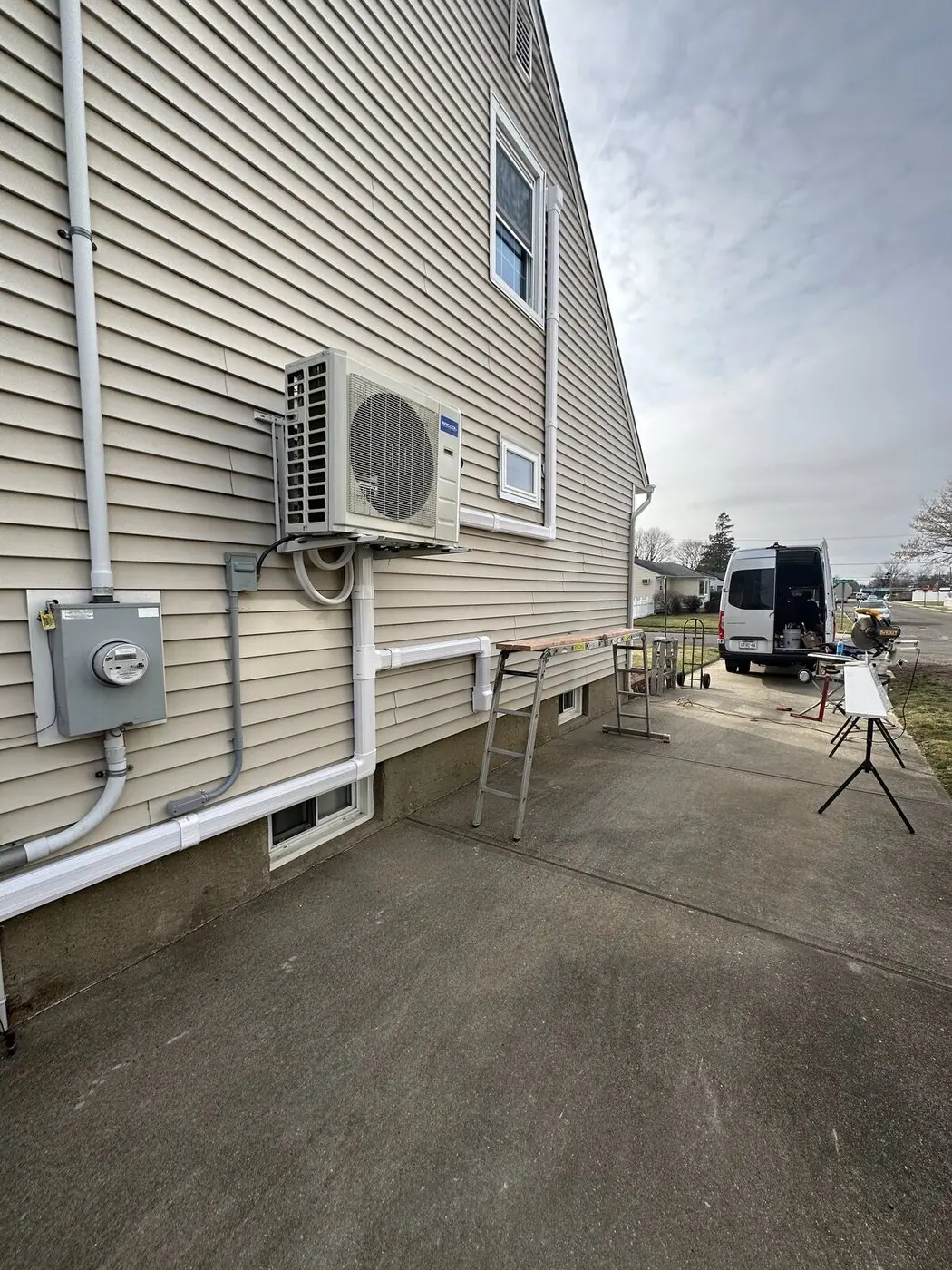
A heat pump does not generate heat by combustion — it moves heat from outdoor air into your home using refrigerant and a compressor. In summer, it reverses and acts as an air conditioner. Cold-climate models, including the MRCOOL ductless mini-split systems we install as an authorized distributor, are rated to deliver full heating capacity down to 5°F and partial capacity well below zero. Long Island's average January low is around 25-27°F — comfortably within a modern heat pump's effective range.
Long Island Climate: Does a Heat Pump Actually Hold Up?
This is the question we hear most. Long Island sits in USDA climate zone 6A/6B. Winters are cold but not extreme by northeastern standards. The concern about heat pumps "not working in the cold" applies to older, single-stage units from the 1990s and 2000s — not to current inverter-driven models.
Today's DC inverter heat pumps modulate their output continuously, running at partial capacity most of the time and ramping up on the coldest days. The result is quieter, more even heating than a furnace that cycles on and off. For a home in West Babylon, Commack, or Massapequa facing a 15°F night, a properly sized modern heat pump will maintain 70°F indoors without issue.
Efficiency and Operating Costs
This is where heat pumps have a clear structural advantage:
- A high-efficiency gas furnace (96% AFUE) converts roughly 96 cents of every dollar of gas into heat. That is as good as combustion gets.
- A heat pump with a Heating Seasonal Performance Factor (HSPF) of 10 or higher delivers 2.5 to 3+ units of heat for every unit of electricity consumed — an effective efficiency of 250-300%.
- Whether that translates to lower bills depends on your local gas vs. electricity rates. PSEG Long Island electric rates are relatively high, but with a well-insulated home and a high-HSPF unit, most homeowners see comparable or lower annual heating costs versus gas — and zero summer cooling bill because the heat pump handles both.
If you are on propane (common in parts of eastern Suffolk County), the math shifts strongly in favor of a heat pump. Propane costs roughly three to four times more per BTU than natural gas on Long Island, making electric heat pumps a straightforward financial win in most propane-heated homes.
Installation Costs: What to Budget
Cost ranges vary by home size, equipment tier, and whether you are adding ductwork or going ductless:
- Ductless mini-split heat pump (single zone): $3,500 to $6,500 installed, depending on capacity and equipment brand. Multi-zone systems covering a whole house range from $9,000 to $20,000+.
- Ducted central heat pump (replacing existing furnace/AC): $6,000 to $14,000 installed, assuming existing ductwork is serviceable.
- High-efficiency gas furnace replacement: $3,500 to $7,500 installed for most residential applications.
- New construction or addition: Costs are more flexible because the system is designed in from the start. A home addition or new construction project often integrates a heat pump more cost-effectively than a retrofit because there is no existing system to work around.
Federal tax credits under the Inflation Reduction Act currently offer up to $2,000 per year for heat pump installations in qualified residences. New York State also offers NYSERDA rebates for heat pumps — rebates have ranged from $500 to $3,000 depending on the unit type and home heating fuel displaced. These incentives do not apply to gas furnaces. We can walk you through what is currently available when you schedule your estimate.
Permit and Code Requirements on Long Island
Both system types require permits in Nassau and Suffolk counties. Key points for Long Island homeowners:
- HVAC replacement permits are required regardless of whether you are swapping like-for-like or changing system type.
- Ductless mini-split installations require a licensed HVAC contractor and typically require a mechanical permit from your town building department.
- If you are adding refrigerant lines through exterior walls, that penetration needs to be sealed to code — an inspector will check it.
- Gas line work in connection with a new furnace (or gas line decommissioning if switching away from gas) requires a licensed plumber in New York State.
We handle permitting on every job. Do not hire a contractor who tells you permits are not required for an HVAC replacement in New York — they are, and an unpermitted system creates liability when you sell.
When a Furnace Still Makes Sense
A gas furnace remains the practical choice in certain situations:
- You have a fully ducted home in good condition and a low gas rate — a furnace swap is faster and less expensive upfront.
- Your electrical service is undersized and upgrading it to support a heat pump adds significant cost to the project.
- You are in a historic district with exterior unit placement restrictions (less common but worth checking in some older Nassau County municipalities).
- You need a short-term fix before a larger renovation — a furnace replacement buys time while you plan a full system overhaul.
The Hybrid Option
If you are not ready to commit fully to either system, a dual-fuel hybrid setup pairs a heat pump for moderate temperatures with a gas furnace that activates only on the coldest days. This approach reduces gas consumption by 50-70% while keeping gas as a backup. It is a solid middle path for homeowners with existing ductwork who want to capture heat pump efficiency without abandoning their gas infrastructure entirely. We can size and design these systems as part of a broader design-build engagement or as a standalone HVAC project.
What We Recommend for Most Long Island Homes
For a new build, a gut renovation, or a modular home, we consistently recommend a cold-climate heat pump as the primary system — the efficiency, the dual heating and cooling function, and the available incentives make it the better long-term investment. For a straight equipment swap in an older home with functional ductwork and a low gas rate, a high-efficiency furnace may be the more cost-effective immediate choice. Every situation is different, which is why we start with a site visit, not a sales pitch.
Milton's Construction has been building, remodeling, and servicing homes across Long Island and Suffolk County for 40 years. As an authorized MRCOOL distributor and installer, we carry and service the full line of ductless mini-splits and inverter heat pumps. We also hold all required New York State licenses for HVAC and plumbing work, so every installation is permitted, inspected, and backed by a contractor you can reach. To get a free, no-pressure estimate on a heat pump, furnace, or hybrid system for your home, call us at (631) 741-0199 or request a free estimate online. We serve West Babylon, all of Nassau and Suffolk County, and the broader Tri-State area including New Jersey and Pennsylvania.

Founder of Milton's Construction. Four decades building and remodeling homes across Long Island. More about us →